Working with Percentiles (and Quantiles) of Distributions
Many times we want to observe different distributional properties of scenario data. The pyam function compute.quantiles() can help!
0. Define timeseries data and initialize an IamDataFrame
This tutorial uses a scenario similar to the data in the first-steps tutorial (here on GitHub and on read the docs).
Please read that tutorial for the reference and further information.
[1]:
from pyam import IamDataFrame

df = IamDataFrame(data="tutorial_data.csv")
df.timeseries().head()
[INFO] 16:21:43 - pyam.core: Reading file tutorial_data.csv
[1]:
| 2010 | 2020 | 2030 | 2040 | 2050 | 2060 | 2070 | 2080 | 2090 | 2100 | |||||
|---|---|---|---|---|---|---|---|---|---|---|---|---|---|---|
| model | scenario | region | variable | unit | ||||||||||
| AIM/CGE 2.1 | CD-LINKS_INDCi | R5ASIA | Emissions|CO2 | Mt CO2/yr | 11231.0880 | 14359.2801 | 14873.5967 | 15238.9081 | 15180.1854 | 15513.1760 | 16003.2060 | 16343.3124 | 17097.8681 | 17722.1245 |
| Primary Energy | EJ/yr | 145.7409 | 191.0565 | 216.2135 | 234.2793 | 245.9771 | 258.3201 | 268.7644 | 275.0764 | 283.1479 | 288.6838 | |||
| Primary Energy|Biomass | EJ/yr | 23.6647 | 24.0751 | 25.9262 | 27.3646 | 29.6938 | 29.8102 | 30.1178 | 30.0109 | 29.6166 | 29.5846 | |||
| Primary Energy|Fossil | EJ/yr | 116.1932 | 155.0735 | 168.2376 | 179.0562 | 185.2168 | 195.6202 | 203.4916 | 207.3614 | 214.7828 | 217.7714 | |||
| Primary Energy|Non-Biomass Renewables | EJ/yr | 4.5139 | 9.2641 | 17.0767 | 22.0967 | 25.3211 | 26.6589 | 27.9490 | 29.3259 | 29.3942 | 30.6799 |
1. Let’s see how many scenarios define CO2 emissions
[2]:
df.filter(variable="Emissions|CO2", region="World").scenario
[2]:
['1.0',
 'CD-LINKS_INDCi',
 'CD-LINKS_NPi',
 'CD-LINKS_NPi2020_1000',
 'CD-LINKS_NPi2020_1600',
 'CD-LINKS_NPi2020_400',
 'CD-LINKS_NoPolicy',
 'Faster Transition Scenario']
2. Get the median
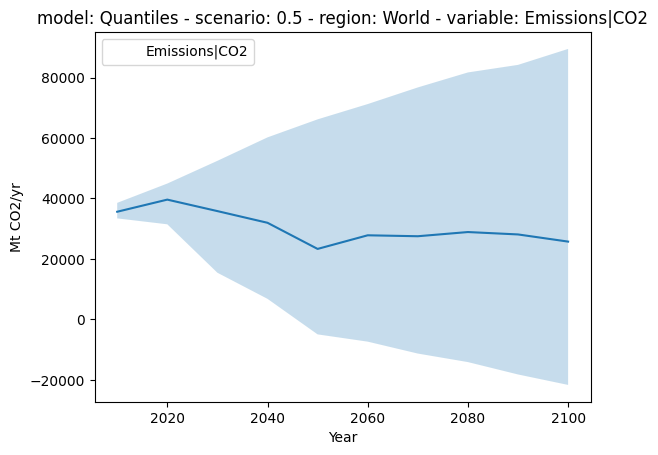
The median is the 0.5 quantile (or percentile) - let’s take a look!
[3]:
from matplotlib import pyplot as plt

fig, ax = plt.subplots()

# plot the background field of scenario data
(
    df.filter(variable="Emissions|CO2", region="World").plot.line(
        color="variable", alpha=0, fill_between=True, ax=ax
    )
)

# plot just the median
(
    df.filter(variable="Emissions|CO2", region="World")
    .compute.quantiles([0.5])
    .plot.line(ax=ax)
)
[3]:
<Axes: title={'center': 'model: Quantiles - scenario: 0.5 - region: World - variable: Emissions|CO2'}, xlabel='Year', ylabel='Mt CO2/yr'>
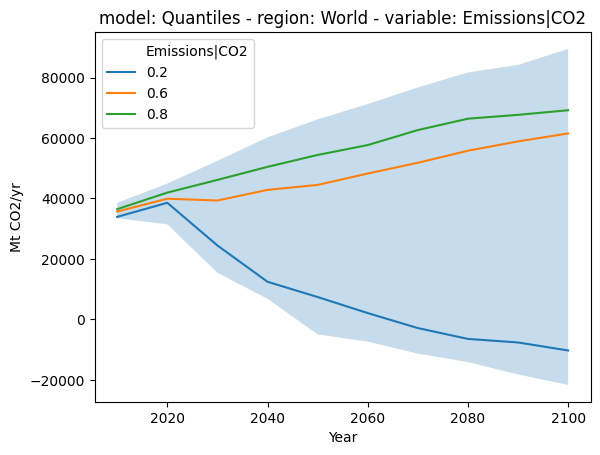
3. Get arbitrary quantiles
[4]:
fig, ax = plt.subplots()

# plot the background field of scenario data
(
    df.filter(variable="Emissions|CO2", region="World").plot.line(
        color="variable", alpha=0, fill_between=True, ax=ax
    )
)

# plot quantiles
(
    df.filter(variable="Emissions|CO2", region="World")
    .compute.quantiles([0.2, 0.6, 0.8])
    .plot.line(ax=ax)
)
[4]:
<Axes: title={'center': 'model: Quantiles - region: World - variable: Emissions|CO2'}, xlabel='Year', ylabel='Mt CO2/yr'>
4. Weighted Quantiles
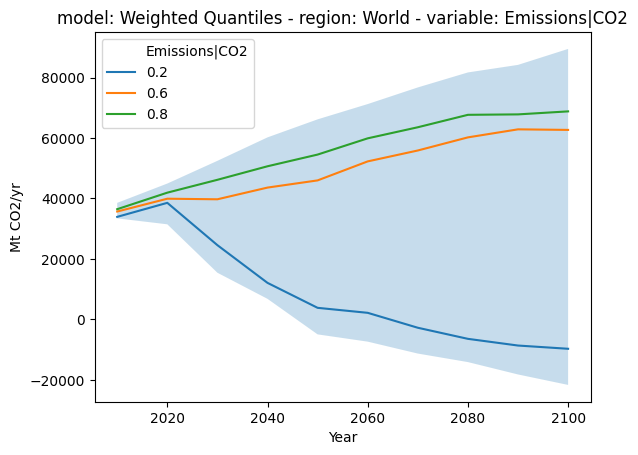
Weighted quantiles are also supported via the wquantiles package and are keyed to model/scenario combinations (unless the level argument is provided to compute.quantiles()).
[5]:
import numpy as np

weights = df.meta.assign(weight=np.random.rand(len(df.meta)))
weights.head()
[5]:
| weight | ||
|---|---|---|
| model | scenario | |
| AIM/CGE 2.1 | CD-LINKS_INDCi | 0.890174 |
| CD-LINKS_NPi | 0.077682 | |
| CD-LINKS_NPi2020_1000 | 0.364202 | |
| CD-LINKS_NPi2020_1600 | 0.305781 | |
| CD-LINKS_NPi2020_400 | 0.191420 |
[6]:
fig, ax = plt.subplots()

# plot the background field of scenario data
(
    df.filter(variable="Emissions|CO2", region="World").plot.line(
        color="variable", alpha=0, fill_between=True, ax=ax
    )
)

# plot weighted quantiles
(
    df.filter(variable="Emissions|CO2", region="World")
    .compute.quantiles([0.2, 0.6, 0.8], weights=weights["weight"])
    .plot.line(ax=ax)
)
[6]:
<Axes: title={'center': 'model: Weighted Quantiles - region: World - variable: Emissions|CO2'}, xlabel='Year', ylabel='Mt CO2/yr'>
[ ]: